Weekly Drought Monitor for the Week ending 3/24/26

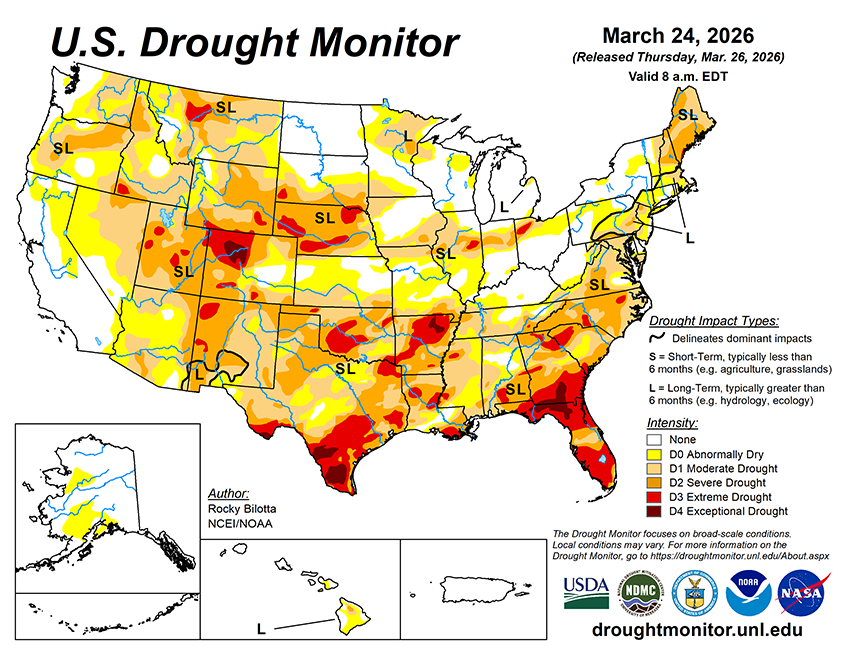
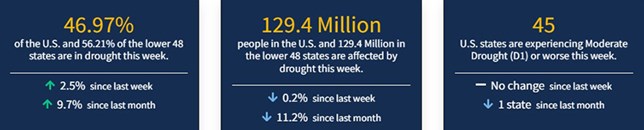
Drought in the Lower 48 States increased 2.5% since last week and 9.7% since last month.

This Week's Drought Summary…

This week, extreme weather events across the United States painted a starkly contrasting picture of drought development and relief. In the West and Plains, a persistent heat dome drove temperatures 20 to 25 degrees above normal, shattering early-season records and significantly increasing evaporative demand. This intense heat, combined with high winds and pre-existing dryness, threatened to rapidly deplete topsoil moisture and fueled explosive, landscape-altering wildfires—most notably the historic Morrill Fire in Nebraska that consumed over 800,000 acres. Ultimately, the combination of soaring temperatures and below-normal precipitation resulted in the expansion of drought and abnormal dryness across portions of the West, Great Plains, and parts of the Southeast.
Conversely, other regions experienced abrupt and volatile moisture influxes that mitigated dry conditions but introduced localized to severe flooding. In the Pacific Northwest, an atmospheric river stalled over Washington, bringing heavy rain and significant snowmelt. Further east, a powerful winter storm delivered a massive precipitation boost in the form of a late-season blizzard, dropping over 50 inches of snow across parts of the Upper Midwest and Michigan's Upper Peninsula. The most extreme precipitation of the week occurred over the Hawaiian Islands, where a stalled Kona low dumped unprecedented, historic rainfall, resulting in excessive flooding, widespread landslides, and infrastructure damage. Overall, above-normal precipitation resulted in improvements to drought and abnormal dryness across parts of the Midwest, Northeast, Hawaii, and Puerto Rico.


Looking Ahead...

Over the next five days (March 24–28, 2026), the contiguous United States is forecast to experience another week of widespread, record-breaking warmth. A strong upper-level ridge will dominate the western and central U.S., pushing temperatures 20 to 40 degrees above average. This extreme heat, combined with dry conditions and gusty downsloping winds, will elevate fire weather risks across the High Plains on Tuesday and Wednesday. Meanwhile, a deepening low-pressure system will bring even stronger winds to the Northern Rockies. Concurrently, a potent mid-latitude cyclone will track from the Pacific Northwest toward the Canadian Maritimes. This system will initially drop moderate to heavy rain over the Northwest—potentially triggering isolated flooding—alongside high-elevation snow in the Olympics and Cascades. After weakening over the Central U.S., the system is expected to reinvigorate over the East by late next week, delivering a mix of rain to the south and snow to the north across the Great Lakes, Ohio Valley, and Northeast.
Further out, the Climate Prediction Center’s 6–10 day outlook (valid March 29–April 2, 2026) favors above-normal precipitation across much of the contiguous U.S. and Hawaii. Conversely, below-normal precipitation is favored for most of Alaska and along portions of the East Coast, stretching from southern New England to northern Florida. Probabilities for above-normal temperatures are increased across the vast majority of the lower 48 states and Hawaii, while below-normal temperatures are expected to persist across most of Alaska and much of the Northeast.